Monday, July 22, 2013

It Happened Here -- Winifred Goldring, Paleontologist


New York City had been growing rapidly throughout the nineteenth century and with its growth came a growing thirst for safe fresh drinking water. The City and the State Legislature looked north to the streams and valleys of the Catskill mountains. In 1905 the legislature enacted a proposal for the damming of the Esopus and Schoharie Creeks to create reservoirs and a system of aqueducts to conduct water to the City. On the Schoharie, the gorge at Gilboa was selected for a reservoir site with the dam running right through the village of Gilboa, requiring that the whole town be razed. Three churches, two boarding houses, many stores, business and homes – some 430 structures were torn down or burned. Seven cemeteries and family burial plots were relocated. In 1917 land acquisitions began and by 1920 excavations for the dam commenced.

           GILBOA SETTLEMENT
       COTTON MILL 1840-1869, TANNERY             
       CHURCH & CEMETERY STOOD ON              NYSHM at Schoharie Dam (now obscured by dam reconstruction)
   GROUND NOW COVERED BY RESERVOIR
     OF NEW YORK CITY WATER SUPPLY
                  STATE EDUCATION
                     DEPT. 1949

As the steam shovels began their work to dig footings, and as crews began blasting out rock from creek-side quarries for the dam, workers began to discover fossil tree stumps.

Some seventy years before, Samuel Lockwood, a local pastor and amateur naturalist had first discovered pieces of fossilized tree trunks, and foliage as well as some distinctive bulbous tree stumps in a quarry along the Schoharie Creek. They had been identified as a species of fern-trees from the Devonian age. They had been located at the edge of a shallow inland sea and buried in a slurry of storm-borne sand.

The New York State Museum was called and a team was rapidly assembled to rescue any significant fossils that emerged before they were covered by the construction of the dam or the waters of the reservoir. Beyond the team's important discoveries, the State Museum's project was significant for other reasons as well. First, it was one of the earliest “salvage paleontology projects” and secondly it was one of the first major paleontology projects headed by a woman.

Winifred Goldring was an extremely bright young woman, graduating from Albany's Milne School as class valedictorian in 1905 and graduating with honors from Wellesley College four years later. She began her college years focusing on classical languages but two required “science” courses (geology and “geography”) set her on a totally different path. As a girl she had collected fossils in the Helderberg Mountains; and her father must have sparked in her an early interest in botany. Frederick Goldering was trained as a master gardener at Kew gardens in Great Britain, and had come to America to manage the exotic orchid collection of Erastus Corning1 a wealthy businessman and politician in Albany. Later Goldring ran a successful florist/greenhouse business from his home in Slingerlands, N.Y. In 1912 Winifred earned her AM degree at Wellesley and took additional courses in geography, paleontology and paleobotany at Harvard, Colombia and John Hopkins University.

In 1914 she was hired by John Mason Clarke, the New York State Museum's third director as a “Special Temporary Expert in Paleontology” to create fossil invertebrate exhibits for the State Museum. Hired to “fill the cases” she worked, instead on creating interpretive exhibits that would educate the public, beginning with exhibits entitled “What is a Fossil?” and “What is a Formation?”
She would go on to create full-sized dioramas that would depict a Devonian Forest and the pot hole deposition site of the Cohoes mastodon bones. Eventually her museum work would lead her into science publications for the general public. The Handbook of Paleontology for Beginners and Amateurs, first published in 1933 went through several publications and was widely used as a college introductory text. The Guide to the Geology of John Boyd Thatcher Park was also published in 1933, and was republished in 1997!

In 1915 she was hired as an assistant paleontologist. Clarke had begun an ambitious review of the literature and of the State's extensive collections of both catalogued and as yet un-studied fossil crinoids (sea lilies), but the project had languished as Clarke was occupied with other museum business. In 1916 he asked Winifred to take over the study. Early on he had been impressed by her scholarship and work ethic, praising her as a “particularly hardy seeker after the truth.” After seven years of comprehensive study she published a 670 page monograph that systematized the ancient crinoids into twenty five families, sixty genera and one hundred and fifty five species, firmly establishing her reputation as a first rank paleontologist.

When fossils began emerging from the excavations and quarry sites at Gilboa in 1920, Clarke and his team began collecting. But again, the press of business at the museum prevented him from devoting adequate attention to overseeing the project. In 1921 he turned over the Gilboa fossil project to Winifred Goldring and her colleague Rudolf Reudemann.


 They would work the site until 1926 when rising reservoir waters would prevent further work. In 1924 Goldring published a synopsis of their work to date at Gilboa in the New York State Museum Bulletin #251. Over forty tree stumps had been found from three successive forests, each having been buried by storm driven sands. In the same layers, but not attached to the stumps were found considerable amounts of fossilized vegetative matter – (apparently) seeds, spore cases,branches and palm-like fronds. 


Based on this evidence Goldring concluded the stumps were a new genus of “seed ferns” she named Eospermatoperis (ie. “dawn of the seed fern”). This designation would stand for eight decades. The publication of this report and subsequent journal articles would make Gilboa and Winifred Goldring world famous.2

Though Goldring had the support and respect of most of her colleagues at the State Museum, many people, including some of her co-workers were uncomfortable with a young single woman doing geological field work, and wished she would confine her work to the laboratory and the museum. Though she participated regularly in professional meetings and conferences, she was rarely invited on collecting expeditions out of state and colleagues mentioned in letters the “limitations of taking women into the field.” To many it simply didn't seem proper for a woman to be seen clambering around rocky outcroppings or picking through shattered bedrock at a quarry or examining the latest discovery at the bottom of a hole at a construction site while construction workers stood around watching. Certainly the fashions of the first decades of the twentieth century were not conducive to such activities, as the voluminous ankle length skirts of the first decade gave way to the pencil thin dresses of the second decade. It would be another twenty or twenty-five years before women commonly wore pants, but Miss Goldring was not to be thwarted. She created her own outfit with bloomers for fieldwork. When other critics and concerned friends raised the issue of her personal safety when working alone un-escorted in the field, around quarries and construction sites, she answered them by learning to shoot a revolver, implying she would work armed, if she was ever working alone and felt threatened.

Perhaps more troubling for Winifred were issues of fair compensation and opportunities for advancement, as a woman. In 1918 she resigned briefly over issues of inadequate salary combined with the pressures of completing her exhibit work and working on the crinoid project. In 1928 she considered applying for a position with the U.S. Geological Survey but was dissuaded by colleagues who alerted her that the survey directors were looking for a “he-man” paleobotanist. The following year in a letter she discussed the issue of whether a woman should go into the fields of geology and paleontology. She pointed out that her salary of $2,300 was half that of the (male) clerks and stenographers at the museum. Generally she encouraged girls to go into other fields – botany and zoology instead of paleontology. Her promotions came slowly but steadily as her dedication to her profession and the quality of her work could not be denied. From 1920 to 1938 she worked as an Associate Paleontologist, during which for three years she held the title of Paleo-botanist. From 1938 to 1939 she was the provisional State Paleontologist until she became State Paleontologist in 1939, the first woman to hold such a position in the United States, and the highest ranked woman in her profession in the world. In 1949 she became the first women elected president of the Paleontological Society and the following year, vice president of the Geological Society of America.

In the 1930's Miss Goldring turned her attention to an unusual rock formation a few miles west of Saratoga Springs. Discover in 1825, by J. H. Steele, he described the site as having “great quantities calcareous concretions...mostly hemispherical. But many are globular and vary in size from half an inch to two feet in diameter; they are obviously composed of a series of successive layers nearly parallel and perfectly concentric; these layers have a compact texture, and are dark blue or near black in colour, and are united by layers of lighter coloured calcareous substance....they are very thin and I have counted more than a hundred [layers] in one series.” The advancing glaciers had sheared off their upper portions leaving them looking something like cabbages, halved and ready to be grated.


Lester Park Rd, south of Co. Rte 21, Saratoga

But what were these things? Both Steele and William Mather, a geologist reporting for the Geographic survey of 1843 he felt they were inorganic concretions. In 1883 James Hall examined the area and discovered within the fossils minute branching “canaliculi”. He named them Cryptozoon proliferium (ie. Prolific hidden life). In 1906 H.M. Seeley confirmed they were organisms but classified them with the sponges. In 1916 G. R. Wieland first advanced arguments that they belonged to a group of algae.

Robert Ritchie, an amateur geologist bought the property that contained much of the outcroppings. Uncovering much more of the area, he opened it to the public as a park, Petrified Sea Gardens, in 1924.  New York State acquired the rest, which became Lester State Park.


In the 1930's Winifred Goldring joined the fray, and with characteristic thoroughness studied the area, for several years. In a 70 page report she concluded they were actually three reefs of ancient algae, each dominated by a different species: Cryptozoon proliferium, C. ruedemanni, or C. undulatum. She described the environmental conditions that favored one or another species. Goldrings conclusions would be supported by studies in recent times by the discovery of living stromatolites found in reefs in Australia and other places.
 
Miss Goldring died in 1971. Her career spanned over 40 years and was marked by significant professional achievements as she rose to the top of her profession, in the face of sustained gender discrimination. While her accomplishments are highlighted in a kiosk type display near the Gilboa Museum which features several of Gilboa tree fossils of the type she discovered and described, she is not mentioned at the Lester Park site. In 1998 Governor George Pataki's administration promoted a series of New York State Historical Markers spotlighting the achievements of Women in New York State.3 Unfortunately she was not among those chosen. Hopefully in the future she will be considered for a Marker, perhaps at the site of her home in Slingerlands.

Marker of the Week -- You have to Wonder,


given the (ah) shall we say, spontaneous habits of cattle if you spend any time marching them back and forth over clay won't they tend to make their own  "contributions" to the clay? Well, of course the bricks were fired....and maybe a little additional organic matter made them stronger.

At any rate, the good Doctor ended up with a handsome house.


                    Buckwheat Bridge Rd., North of Clermont


1Erastus Corning was the grandfather of Erastus Corning III who held office as Albany's mayor for 43 years.
2In 1935 German scientists would call into question the classification of these trees as “seed fern” but it would not be until 2004 that paleontologists would find at Gilboa two complete Eospermatoperii with their trunks and foliage intact. Their announcement of their discovery in 2007 would begin a process of reclassification that continues to this day.
3 Recent posts on this blog have featured Alida Livingston and Amelia Bloomer


Monday, July 15, 2013


It Happened Here -- The Mexican War: So Long Ago, so Far Away


It is hard to imagine an event in American History less likely to produce New York State Historical Marker references than the Mexican War. Fought wholly in California, Texas and Mexico; hotly debated in Washington; the subject of so much concern in the South and southern frontier areas, with an increasing subtext for the future of slavery in the United States, the war seems pretty remote from New York State's history--at least this is what I presumed, until I stumbled upon this marker in rural
Near Co. Rte's 29 & 39 & NY 32, "Bacon Hill" North of Schuylerville


Saratoga County.  But of course, New York has been the home to soldiers in all of America's wars, and has produced men and women who have participated in virtually all of American history.
Since then I have encountered two other markers of New Yorkers who went on to play significant roles in the Mexican War and the years that followed.  Since I had heard of neither of them I could not help but do some research...

William Jenkins Worth was born to parents Thomas Worth and Abigail Jenkins who lived on Union St. in the City of Hudson in a house as solid and unadorned as their Quaker faith. William rejected the pacifism of that faith when he enlisted in the 23d Infantry early in the War of 1812. He came to the attention of Brigadier General Winfield Scott becoming his aide-de-camp and distinguishing himself in the battles of Chippewa and Lundy's Lane. At the end of the second battle Worth received a wound from grape shot that nearly killed him and would leave him lame for the rest of his life. After the war, Worth remained in the Army securing a position as Commandant of Cadets at West Point.  
With Superintendent  Sylvanus Thayer he would usher in a new era of integrity and professionalism  in the military. In 1842 Worth was given the task of ending the 2nd Florida Seminole War which had dragged on for five years. Winning the battle of Palakta and destroying the Seminole's crops and settlements he forced 3000 to surrender and established a de-facto border with the remaining 300 to bring the war to an end.

Ordered to Texas, Worth became General Zachary Taylor's second in command and fought in the first battles of the Mexican War. In 1847, he along with most of Taylor's army were transferred to a new army being formed to capture the capital of Mexico, led by his old protege Winfield Scott. 

The Mexican War was the first American conflict where events were witnessed and reported by newspaper reporters rather than retold or summarized from official after-action reports and letters and interviews with travelers or other witnesses to the events. The advent of telegraph communications and reliable steam ship transportation made news reporting from the field possible. Colorful figures and dramatic events sold newspapers and the athletic, dynamic General Worth with his ramrod posture made good press. Worth, eager to enhance his reputation, had a flair for the dramatic. At the amphibious landing at Vera Cruz, General Worth was the first American ashore, leaping into chest deep water to lead his men into battle. At the final battle of Chapultepec castle, again at the head of his division, Worth personally tore down the Mexican flag over the castle to replace it with the American colors. By war's end General William Worth was the most famous living American General.1

Like many famous military men General Worth was more than a little vain and jealous of his good reputation. (Subordinates nicknamed him “Haughty Bill”) He was also supremely confident in his opinions. In the Battle of Molino del Rey, leading up to the conquest of Mexico City, Worth concluded Scott's orders to him would lead to costly tactical errors. His disagreement with Scott escalated until Scott had him briefly arrested for insubordination. Worth never forgave his mentor. The general from Hudson had named his son Winfield Scott Worth. Following the incident he had his 7 year old son's name changed to William.

At the conclusion of the Mexican War, Worth was approached by Cuban revolutionaries. Building on their common bond as Freemasons they induced him to aid them in liberating their county from Spain. Worth accepted money from them but he was abruptly transferred to Texas, and the plot came to nothing.

In Texas, Worth began establishing his military administration and preparing for protracted defensive operations against Apache and Comanche raiders, when suddenly he was cut down in a cholera epidemic. At age 55 the vigorous, athletic General was dead. Fort Worth Texas was named in his honor. Seven years after his death the celebrated war hero was re-interred in New York City beneath an ornate obelisk at 5th Avenue and Broadway. Some researchers have suggested that a vindictive Winfield Scott worked to obscure his reputation, even going so far as to see some of his records were destroyed. A more likely explanation is that within a dozen years the United States would be engulfed in a far greater war and soon a whole panoply of new generals and war heroes would occupy the attention of Americans.
                                                                      ***********

John Anthony Quitman was born in Rhinebeck, New York in 1799. His father, Frederick Quitman, a Lutheran pastor, had emigrated from the Rhine-lands coming first to Schoharie. In 1789 he resettled in Rhinebeck with his wife and several black slaves2 His new congregation built him a parsonage, a compact “Adams style” house along the Kings Highway that ran to Albany. John Quitman would receive an education in the classics at Hartwick Seminary before moving to Chillicothe Ohio where he pursued a law career. 


In 1826 John Quitman bought a plantation in Mississippi, near Natchez3. Quitman practiced law and politics, building a career first in the Mississippi House of Representatives, then the Senate, then as head of the Senate as acting Governor, before becoming a judge on the Mississippi High Court of Errors and Appeals. By 1834 his plantation had over fifty slaves and Quitman had become as fully a member of the southern plantation aristocracy as any of his southern-born peers. His views on nullification (the doctrine that states had the right to nullify any federal laws detrimental to their interests) were more extreme than many Mississippians, at that time.

When the Texas revolution began Quitman wrote Sam Houston encouraging him to action and recruiting a force of volunteers to support him. The “Natchez Fencibles” marched and counter-marched in East Texas before learning Huston had defeated the Mexicans.

When the Mexican War began Quitman was commissioned a brigadier general of volunteers, and like Worth, served in Texas under Zachary Taylor, then transferred to Scott's expedition, and fought in many of the same battles. Worth and Quitman stormed different entrances to Chapultepec and Quitman's force was the first to enter Mexico City.  Scott appointed Quitman military governor of the City.

Returning to the United States, Quitman ran successfully for governor of Mississippi.  While governor he became associated with the "fire-eater" faction of southern politicians who openly advocated succession to protect slavery in their states.  During this time, he, like Worth before him, was enlisted by Cuban revolutionaries,  who suggested Cuba might become a U. S. slave holding territory or state.  At the time the Franklin Pierce administration gave tacit approval for such plans. Only when the Pierce government realized they were poisoning their support among their Northern Democratic base did they reverse themselves, and indicted leading conspirators including John Quitman for violation of Federal Neutrality laws. Quitman resigned the governorship in 1851 to focus on defending himself.  The prosecution was dropped after several juries failed to reach a decision.

Also, like General Worth, John Quitman died unexpectedly, "before his time".  Quitman came to Washington in the spring of 1857 to attend the inauguration of President James Buchanan, and stayed at the National Hotel, where the President-elect was staying.  Both became sick, along with many others from what has been described as a virulent form of dysentery and the "National Hotel Disease". Some believed it was part of a mass poisoning plot, a theory given some credence by the fact that cases lessened when Buchanan left the hotel for a visit home but continued when he returned. More likely it was caused by poor sanitation. Water and sewer pipes had burst in the hotel during a cold snap the winter before. In all some 400 people were sickened and perhaps a dozen died. Buchanan suffered for six weeks making his weak presidency even more irresolute. Three Congressmen succumbed, including Quitman who lingered at his plantation until dying the following summer.  One can't help but wonder what roles this transplanted New Yorker might have played in the Confederate government or perhaps on civil war battlefields, had he survived.


1One is tempted to draw comparisons between Worth and some of the most famous generals of the twentieth century. Images of George S. Patton riding a tank, or standing in a squad car in his cavalryman's jodhpurs with his pearl handle Colt 45's certainly come to mind as do those of Douglas (“I shall return”) Mac Arthur striding ashore through the surf in the Philippines, (then doing it several more times to make sure the cameramen got it all on film.)
2New York had begun the gradual emancipation of its slaves, back to 1799, freeing in 1827 all male slaves when they reached their 28th birthday.
3Monmouth Plantation would eventually house 300 slaves and encompass 1500 acres. The plantation house would survived the Civil War and exists today as a five star inn.
Marker of the Week  -- Place Names spellings persist


NY Rte. 9 at Dutchess/Columbia line
While our language often changes relatively quickly (see the Marker of the Week post for
April 14, 2013, "Schuyler's Intrenchments") our spelling of place names  remains pretty conservative, retaining older spellings. Consider the number of "tons", centuries after "to'n" ceased to be a contraction for "town".  Of course, often a city is named after an older city.  Kingston, New York for example, may have been named for any one of numerous Kingstons in Britain. More likely it was named for James the Duke of York, proprietor of New York with an eye for flattering him, following his ascendency to the English throne in 1685.          .
A more remarkable fact was that there seems to have been no discussion of changing the name of Kingston, after the King's army burned it down in 1777!

Monday, July 8, 2013

It Happened Here -- Those Remarkable Schoolcrafts


It Happened Here -- Those Remarkable Schoolcrafts

If you haven't had a course in Anthropology or you aren't from the northern Mid-west you might draw a blank if you hear the name Schoolcraft.  Henry Rowe Schoolcraft was a New Yorker, born and educated and introduced to the world of business via his father's Hamilton glass foundry. But it was in the Ozarks and the northern Midwest as an early explorer, discovering the source of the Mississippi River and as a student and recorder of the folkways and legends of the Chippewa and other Great Lakes Indians where he became famous. (In Missouri a freeway, in Michigan three townships and a college with 36,000 students, on Michigan's northern peninsula a county, and in Minnesota a state park are all named for H. R. Schoolcraft.) 

Henry Schoolcraft was a serious, studious boy whose middle class father sought to introduce him early into the family business in Guilderland. At age 13 Henry was responsible for the family's company store at the glassworks. The next year he became an overseer, and at age 15, entered Union college to study chemistry, geology and mineralogy. 


Willow Street, Guilderland


"...Hamilton Glass wks made bottles, window glass, closed 1815"--Foundry Rd. Guilderland
By age 17 he was superintendent of a new glassworks his father had organized in Geneva, New York but within two years the directors of the plant had decided not to renew his contract. It is not difficult to imagine how the bookish, some said priggish, young man who owed his job to his father's influence, might have run afoul of traditional foundrymen and gaffers. In 1813, Lawrence Schoolcraft found another position for his son as a superintendent at a struggling glassworks in Salisbury township in Vermont.  In Vermont he studied further under the tutelage of a professor from Middlebury College. When, the failing business was unable to continue paying his salary, Lawrence and his son bought a glassworks in Keene, N.H. and Henry became its proprietor and superintendent  The end of the War of 1812 brought a recession, exacerbated by the British dumping large quantities of consumer goods (including glassware) on the American market. Henry made some bad business decisions and the Keene enterprise went bankrupt.  Henry returned to his father's home, now in Geneva,  in disgrace. His return was made more difficult by the knowledge that his brother-in-law       Willet Shearman who succeeded him at the Geneva glassworks had created a thriving business making window glass. 
"GLASS FACTORY
  BAY
  1810 - 1850
  ONTARIO GLASS MANUFACTORY
  BLOWERS OF WINDOW GLASS
  VILLAGE OF 500 INHABITANTS "                    On Rte. 14  1 1/2 Miles S. of Geneva

 
Within a year Henry left his father's home to explore opportunities in the West. He found his way to Missouri where he joined up with another New Yorker, Levi Pettibone . The two amateur explorers set off into the Ozark Mountains to look for lead deposits. Henry had some success with a paper he had written about manganese mining and hoped he capitalize on it with a commercially successful book that would examine the prospects for mining the lead deposits in this little-known region.1 The inexperienced explorers, after losing most of their supplies when their pack horse floundered crossing a stream, and becoming lost for several days, was befriended by a hunter-mountain man and Schoolcraft was able to fill several notebooks full of useful information and write his book. 
 
Henry journeyed to Washington to promote his book and look for employment. Though a meeting with President Monroe came to nothing, a meeting with Secretary of War, John Calhoun was more fruitful. Calhoun was organizing an expedition with Michigan territorial Governor Lewis Cass into the headwaters of the Mississippi to impress the Northern Indians who continued to be aligned with the British and to survey and explore the area. Calhoun recommended Schoolcraft as the expedition's geologist. For four months Schoolcraft travelled with the expedition exploring central Minnesota and coming within a few miles of the source of the Mississippi before being thwarted by low waters, then heading east to trace the shores of Lake Superior and Huron back to Chicago. ( A few years later Schoolcraft would return to discover the Mississippi's headwater which he would name Lake Itasca.)
In 1822 the glassmaker, turned explorer secured a position as Indian Agent at Sault Ste. Marie. The same year he married Jane Johnston daughter of a Scots-Irish fur trader and his Ojibwa wife. She was largely responsible for setting him on a path of studying Native American culture, its legends and myths that would occupy his attention the rest of his life. Articulate and cultured, she taught him the Ojibwa language and explained to him many Ojibwa legends and stories. Together they wrote The Literary Voyager, the first magazine produced in Michigan. She, herself, wrote poetry in both English and Ojibwa. Together they had four children.
Though Schoolcraft became a devoted recorder of Native American culture, he came to believe the only way to save Native Americans was through assimilation, giving them the tools to become “Americanized” As an agent of the U.S. Government he helped negotiate the 1836 Treaty of Washington through which the Ojibwa ceded 13 million acres of land in exchange for an annuity, training in agriculture and related crafts to transition them to an agricultural life.
In 1839 Schoolcraft began to publish his Native American studies under the title Algic Researches. After the Democrats lost power in 1841, Schoolcraft lost his position as Superintendent of Indian Affairs for the Northern Department and he returned with his family to New York, where he took up the study of the Iroquois League. In 1842  Jane Johnston Schoolcraft died.
Four years later Congress commissioned Schoolcraft to write an encyclopedic reference work on American Indians. While in Washington, the next year he met and married Mary Howard from Beauford, South Carolina, a widow from a wealthy slave-owning plantation family. Her strength, aristocratic bearing and Cultured manner must have appealed to him for in other respects she was an unlikely partner. The future Mrs. Schoolcraft was a staunch defender of slavery who condemned miscegenation! Such beliefs quickly alienated Henry's two surviving children and it is difficult to see how the marriage would have survived if fate had not intervened. The following year Henry Schoolcraft suffered a debilitating stroke. Mary Howard Schoolcraft became his devoted nurse and caregiver, and despite her views of the racial inferiority of non-white races she worked closely with him as his secretary and transcriber, allowing him to eventually finish his massive work.2

1To this day, southern Missouri remains the center of lead mining in the United States.
2In 1860 she gave full vent to her racist opinons, joining the ranks of a dozen or more “Anti-Tom” authors from the south who sought to “correct” the picture of slavery presented in Harriet Beecher Stowe's Uncle Tom's Cabin. The book was a “best seller,” though no where nearly as popular as Beecher Stowe's book. Mary claimed her husband fully supported and encouraged her, though it is difficult to imagine how the severely disabled and dependent Henry Schoolcraft would or could have objected.
 

 Marker  of  the Week -- A Man's Home is his Castle
Andrew Jackson Downing was one of America's first self-appointed arbiters of good taste. In the 1840's he railed against Americans building Gothic palaces or castles out of anything but stone. "If a man is ambitious of attracting attention by his house and can only afford wood let him...build a gigantic wigwam of logs and bark...but not attempt mock battlements of pine boards and strong towers of thin plank." (quoted in The Hudson, by Carl Carmer, p.177)  John L. Schoolcraft (Henry's Uncle) was unimpressed.


                       Western Ave (Rte. 20)  Guilderland

Sunday, June 30, 2013

It Happened Here --The Tough, Wiley Scotsman and his Diligent Vrouw


Robert Livingston (“the elder”) arrived in Charleston, Massachusetts Bay Colony in 1674 at age 20 with little more than a few letters of introduction prepared by his father Rev. John Livingston.  John Livingston was a presbyterian cleric whose Puritan leanings had increasingly put him at odds with the established church promoted by King James II.  John had emigrated to avoid trouble to Rotterdam, Netherlands with his wife and youngest son, Robert, when the boy was nine years old. The Reverend quickly became a leader among the Presbyterian Scots living in voluntary exile there. The young Robert put his time to good use, becoming fluent in Dutch, and learning about business in perhaps the best school of business in the mercantile world, a Dutch counting house.

Arriving in Massachusetts the young Livingston used his letters of introduction to secure a loan and a stock of trading goods and set off for Albany. The colony of New York had just returned to English control, having been held briefly (1673-1674) by the Netherlands during the 3d Anglo-Dutch War. During that period traders from Massachusetts had reestablished trading links with Albany Dutch fur traders whose source of English trade goods had been cut off by the war. Now with the English (viz. The Duke of York) back in control, the Duke was insisting that all imports and exports be trans-shipped through the port of New York where duties could be levied on them. Livingston established himself as an agent for two of these Massachusetts traders as he was both fluent in the Dutch language and familiar with Dutch business practices.

Dominie Nicholas Van Rensselaer arrived in Albany about the same time as Livingston to share the pulpit of the Dutch Church in Albany and assumed the directorship of Rensselaerwyck when his brother, Jeremias, became incapacitated, then died, in the fall of 1674. Nicholas hired the young Scot for the position of secretary of Rennslaerwyck, and clerk of the Albany General Court, which by tradition were linked together. The receiving of quitrents and city taxes were part of his official responsibilities. Livingston was unafraid of courting public disapproval. When he negotiated for his salary he asked for a 5% commission on everything he collected, and having got it, appears to have pursued his official duty with tenacity. The following year Governor Andros traveled to Albany to negotiate a treaty with the Iroquois Confederacy. The young entrepreneur met the governor and charmed his way into a position as secretary of the New York Board of Indian Commissioners.  In all these positions fluency in Dutch was essential because not only were most litigants in the court Dutch speakers, and the traders engaged in the Indian fur trade were Dutch, but the Iroquois and Hudson River Indian diplomats/interpreters, themselves, generally spoke Dutch rather than English, at this time. Soon, as a political insider and self trained lawyer, Livingston began selling his services as a legal counselor. The young Scot also used his contacts and insider knowledge to further his fur trading enterprises. But as he continued his trading activities he continued to be plagued by a lack of capital. He spent a great deal of time and effort putting off creditors, while pursuing those who owed him money. Even his salaried clerical and secretarial positions were of little help. Both the Colony and the Patroonship were slow in paying the salaries owed him.

The young Robert appears to have had an active social life. There are references to at least two young women who occupied his attention during this period.1 But he chose to court and marry a women who would do the most to improve his financial situation and elevate his social position. In 1679 he married Alida van Rensselaer who was the young widow of Nicholas van Rensselaer his former boss, after he died in 1678. In 1680 Alida was appointed to administer the Van Rensselaer's extensive land holding. As important as her wealth was to the struggling young capitalist, her family connections became more important. Alida was the daughter of Phillip Pieterse Schuyler, one of the foremost Albany fur traders. Her five brothers were all active in the business of the colony; and her sister was married to Stephanus Van Cortland a wealthy and powerful New Yorker. The effect of the marriage was almost instantaneous as the frequency of dunning letters from creditors decreased, to be replaced by offers for loans and business opportunities. Soon after they were married, Livingston brought suit on behalf of his wife for her share of the Manor of Rensselaerwyck. Though ultimately he was unsuccessful, his efforts earned him the approval of the Schuylers, and marked him as a man to be reckoned with.  Alida, for her part became a beloved and valuable help-mate, bearing him nine children, and running his enterprises for him, first, in Albany and later on the manor when he was away for extensive periods in New York City, and in England.2

Livingston Circle, Livingston

Like most men of his age, Robert Livingston associated his aspirations for greatness with acquiring large tracts of land. He petitioned Governor Andros for the right to buy 2000 acres from the Wappinger Indians along the eastern shore of the Hudson where the Roeliff Jansen Kill enters it. He received permission and negotiated its purchase for some 300 Guilders worth of muskets, gunpowder, wampum and various trade goods. In 1684 the new Royal Governor, Thomas Dongan bestowed on it a Royal Patent. The next year he applied for, and got permission to buy an additional 600 acres on the Massachusetts border, along the upper reaches of the Roeliff Jansen Kill, in an area the Indians called “Tachkanick”. The following year the two parcels were united by Dongan into one “Lordship or Manor of Livingston...with full power and authority at all times for ever hereafter in said Lordship and Manor one Court Leet and one court Baron to hold and keep”. Carelessly the Governor, by his act united the two tracts of land which were miles apart into one, turning Livingston's 2,600 acres into 160,000 acres and giving him and his heirs the right to adjudicate all civil and most minor criminal matters among his tenants on his new manor.


 Though Livingston's road, connecting separate parts of his manor principally benefited himself, by declaring it a "king's hie way" Livinston, no doubt. was angling for royal support, or at least hoped to claim royal protection against highwaymen. County Rte 10, Linlithgo


 An early map of Livingston's Manor labels this county road
a "waggon path" County Re 10, Linlithgo


Livingston had done his utmost to ingratiate himself with both Andros and the new Governor, and was becoming an important insider in the Albany government. The Van Rensselaer's having recently thwarted his attempts to take a share of their manor may have seen the value in supporting Livingston's efforts to gain a manor of his own. And finally, Livingston, like many successful colonial businessmen was making substantial loans to the governor. In an era when disbursements from the crown and local taxes often lagged far behind colonial government expenses, by 1689, the Governor personally owed Livingston  £ 3000 for sums Livingston had advanced him!

Though Robert built his manor house on a hill overlooking the Roeliff Jansen Kill in 1692 the lands of the manor remained largely unpopulated for many years. By 1700, in all of Livingston's vast holdings only four or five tiny struggling farms could be found along its banks.  The fact was there were simply too many other places from New Jersey to the Carolinas where settlers could buy land free and clear, farm it without burdensome rents and obligations and some day sell it with improvements they had made on it for its full market value. Not until 1710, with the arrival of a new governor, would this situation improve. Robert Hunter arrived at his new post with a scheme to produce naval stores for the British navy. The “War of the Spanish Succession” had produced a wave of German refugees from the Rhineland Palatinate that crowded into tent cities in open fields south east of London. The war also made the procurement of naval stores – pitch and pine tar, essential for ship building, produced in countries ringing the Baltic sea, expensive and difficult to obtain. Hunter reasoned if a large number of these refugees could be indentured3 and transported to America to produce naval stores from the apparently abundant stands of native pine trees, both problems could be alleviated. Hunter arrived at his new office bringing with him between two and three thousand Palatines and after some delay established them in two settlements, West Camp, on the western side of the Hudson, north of Saugerties, and East Camp on land within Livingston's Manor.


Site of the Palatines' first church in West Camp, on Rte 9W. Another state sign, now missing, near here proclaimed:
"West Camp,  Settled 1710 By Paletines from the Rhineland For Production Of Naval Stores. Built Church and School During First Winter."


 The government bought back a 600 acre parcel of land that contained large stands of white pine trees, paying the Lord of the Manor £400. Livingston was also appointed the government's “victualer”, contracted to supply each of the Palatines with daily rations of 1/3 of a loaf of bread and a quart of ship's beer for the duration of the project. And, he became a salaried inspector of the camps, at £100 per year. While he and his sons scoured the countryside for wheat at the best prices, Alida, his wife ran the baking operations from the manor. She would eventually run most of the family business on the manor, selling commodities from the manor storehouse and extending credit when necessary. 


 A Town Park in Germantown commemorates the Palatines of East Camp, Palatine Park Rd.


Site of the Palatine Church in "East Camp" State Rte 9G  in Germantown


The naval stores project, however, was fraught with problems. Naval stores, like many other specialized commodities in the 17th and 18th centuries were produced by craftsmen using trade secrets that the English imitators had little access to. More importantly, the white pines of North America were poor sources of the resins necessary for naval stores4. And finally the Palatine peasant-farmers, themselves, though they were desperate to escape their war – devastated homelands, had little enthusiasm for the hard, dirty work of producing pitch and pine tar, and for the prospect of what seemed to be perpetual bondage. Livingston, also had difficulty fulfilling his contract. The war that brought the Palatines to America was manifesting itself as Queen Anne's War in North America . With war preparations underway for an invasion of Canada, wheat had become scarce, and expensive. Livingston cut back on the rations he supplied to the Palatines.
In 1711 the Palatines rebelled and Governor Hunter sent soldiers into the camps to put down the rebellion and ensure that the Palatines continued to work. Time passed and no shipments of naval stores were forthcoming. Money for the project dried up and in 1713 Hunter was forced to admit defeat and release the Palatines. Many left for the Mohawk and Schoharie Valleys where other Palatines had settled earlier.


 On State Rte 146 between Guilderland and Altamont


 Some eventually emigrated to Pennsylvania where Germans had settled and they encountered less hostility than they faced in New York.  A large number of Palatines had taken loans from Livingston, and indebted to him, they were obliged to become the first large group of tenants on the manor.

By 1715 the British government had begun to rethink the wisdom of its large scale grants of land given out to friends of the king and colonial governors. Britain was becoming anxious to see its colonies fill out with settlers and develop, particularly in the light of French incursions into its western reaches. But the Crown's large grants of land were often allowed to lie, unpopulated, as their speculator/ owners waited for land prices to rise or they became preoccupied with other matters. Several of these grants had been taken back by the government. The area that included West Camp, where the Palatines were settled, for example, had been the Evans grant of 6300 acres, repossessed by the Crown. In the light of these developments. Livingston sought to reconfirm his patent and applied to Governor Hunter. The exact nature of what Livingston offered Hunter is unknown, though Hunter was indebted to Livingston for several thousand pounds. Whatever it was that Hunter sought to gain, he issued Livingston a new patent for Livingston Manor and with it he created a new Provincial Assembly district, centered on the lands of the manor. With its freeholder/electors beholden to the Lord of the Manor, Livingston was assured of a seat in the Assembly for many years to come – his own “pocket borough” of the type notorious in the history of British Parliamentary politics. It wasn't long before Livingston's charm and political instincts secured for him the Speaker's chair of the Assembly which he held until his retirement in 1725. From it he furthered his financial interests and helped insure that his loans and outlays for government projects would be repaid. From it he also developed a political philosophy of opposition to British taxation and control of the colonies that he would share with most of the colonial Livingstons who came after him.


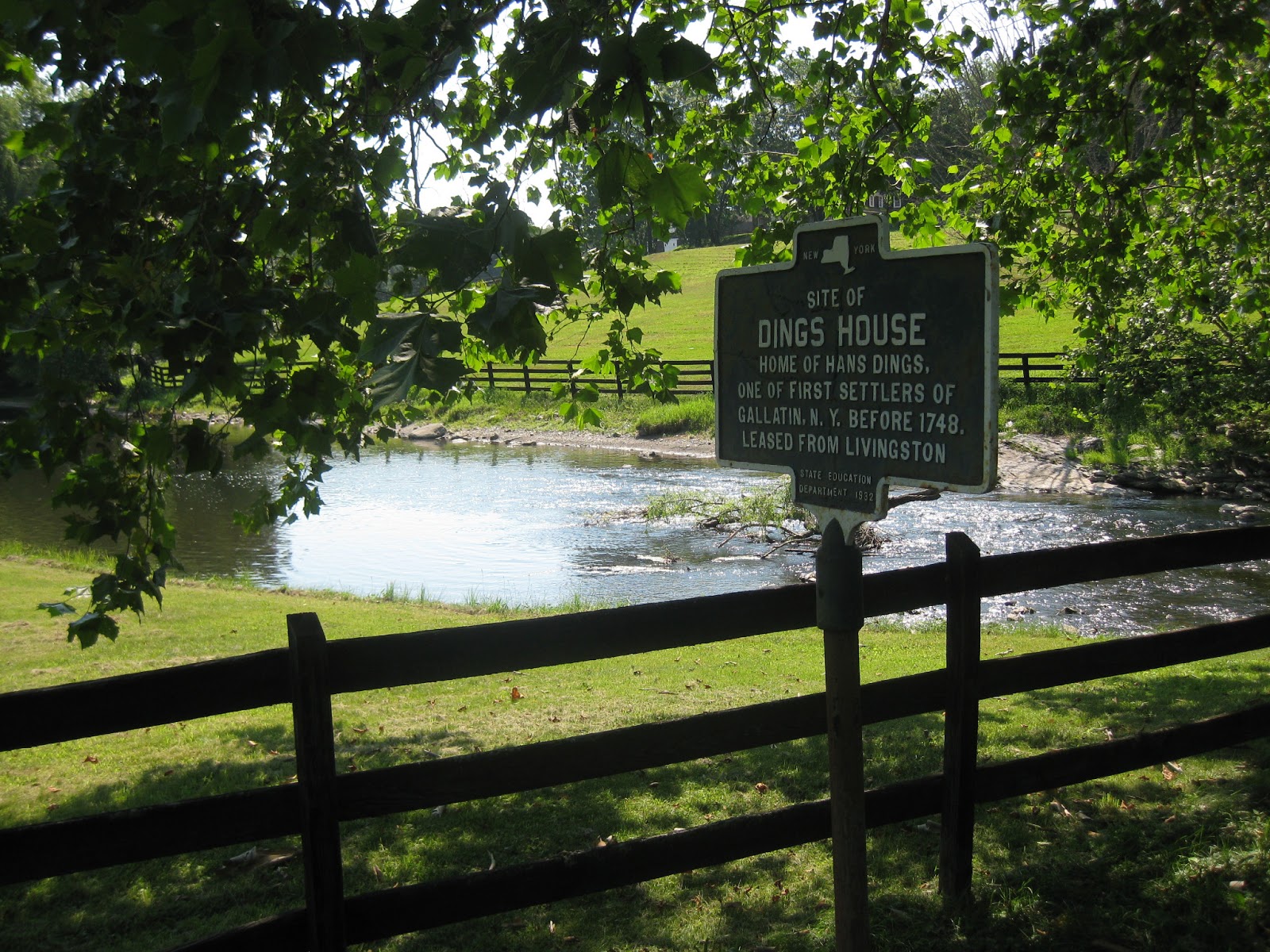
Site of Tenant Hans Dings House, on the Roeliff Jansen Kill, Silvernails
The population on the Manor continued to grow slowly, both from new tenants and black slaves that the first Lord of the Manor acquired. A census in 1718 reported 126 Palatine households, some 499 tenants were living on the manor. For several of their last years both Robert and Alida were in poor health. Livingston worked to carefully preserve his legacy, even to the extent of securing the political offices he had acquired for his eldest surviving son, Phillip, who became the 2nd Lord of the manor. To Robert Jr. he gave 160,000 acres at the southern end of his estate,  that became the manor of Claremont. A family tradition holds that Robert Jr. with conspicuous bravery once thwarted an attempt by slaves to kidnap or kill the elder Livingston, and so he was given special consideration, though there is no apparent documentary evidence to substantiate this story.5

In 1728 the tough Scotsman who made a personal empire, starting with little more than talent, ruthless determination and cunning, died. He was preceded by his remarkable wife and partner in business and life a year earlier.

Wire Rd., Linlithgo

Marker of the Week -- Right Location, Wrong Battle?

 While NYSHM's are usually pretty accurate, their location  is occasionally wrong.  In this case, the reverse seems to be true. In 1755 Colonial forces and their Indian allies under William Johnson collided with French Regulars and their Indian allies. In a number of bloody engagements Johnson fought off the French under Baron Dieskau. The Baron was wounded and captured and the French broke off the battle retreating back north.  Following this Battle of Lake George, Johnson built a fort, Fort William Henry, on the high ground next to the battlefield.  Two years later, in 1757, the French returned to lay siege to the Fort, this time led by Montcalm. (When the Battle of Lake George occurred Montcalm had been living the life of a contented rural squire in the French countryside with his two young daughters, which he adored.) During this later battle, known as the Battle or Siege of Fort William Henry, the Colonial forces occupied a fortified encampment on the older battlefield. It is here in huts their sick and wounded were probably housed. Other wounded, from the siege itself were sheltered in the casements of the fort itself. Following the textbook siege that left the Fort shattered and indefensible the British Commandant surrendered,  with the understanding that the garrison and their families would be permitted to leave for Fort Edward unharmed. The Indian allies of the French, however, felt they were being cheated out of the spoils (scalps, prisoners and plunder) they were promised. After the surrender they rampaged through the British fort and encampment, scalping and taking whatever they could.

E-Mail Me: If you have comments about this blog or any other thing having to do with NYSHM's I would be delighted to hear from you. I would be especially interested if you know of any new or interesting markers or can report on any efforts to restore old markers. My email is tba998@gmail.com I look forward to hearing and sharing your thoughts on this blog. 


1 Court records also reveal a suit brought against him when he borrowed a violin to entertain his friends, and tried to return it to the owner,  broken in three pieces!
2Unlike English society in the 17th and early 18th Centuries, Dutch society regarded women much more as equals in the world of business. Women did not give up their “surnames” when the married. They owned property and often ran their own businesses. After marriage, they often became full partners with their spouses.
3Indentureship was a common practice in Colonial America
4Later in the colonial period several species of southern pines would be found to be excellent sources of resins for naval stores, leading to a major industry in the south, including in North Carolina, “the tar-heel state”.
5John, the eldest son died a few years before, while pursuing his father's interests in London. A younger son, Gilbert, mismanaging his affairs almost to the point of bankruptcy. He was bailed out by his father, but not included in the will.


Sunday, June 23, 2013


It Happened Here -- The "Lily"


Amelia Jenks, like a surprising number of her sisters and brothers in the social reform movements that swept through America in the first 60 years of the 19th century had been born and raised in central New York.  This area had been host to so many pentecostal type religious reform movements and fiery  traveling religious speakers that it became known as the "burned over" district. While these preachers' central message had been that individuals could save their souls by accepting Jesus Christ, implicit in that message was the notion that individuals through their personal actions and choices could improve their lives, reform their society, and create in a small measure, a heaven on earth. It was this notion that inspired the girl from Homer, New York, and so many of her contemporary central New Yorkers.

In 1830 Amelia married Dexter Bloomer, a lawyer, and they moved to Seneca Falls,  New York where he edited a newspaper the Seneca Falls County Courier. Though Amelia had only two years of formal education she was soon regularly contributing to his paper. Active in her church, she became involved in the Seneca Falls Ladies Temperance Society in 1848. Americans had been heavy drinkers since the earliest colonial times, with homemade low alcohol beers providing a safe alternative to often fetid and disease laden water available to early settlers, but the post-revolutionary war era saw the rise in popularity of much higher alcohol content—distilled beverages, bourbons and rye whiskeys. Widespread inebriation had become a social problem, having the greatest impact on women and their families. She would write,

“Intemperance is the great foe of her (women's) peace and happiness. It is that above
all that has made her House desolate and beggared her offspring....Surely she has the
right to wield her pen for its suppression.”

The Lily, a newspaper for 'home distribution' was started by members of the Ladies Temperance Society in1849 but by 1850 Amelia Jenks Bloomer would be its sole editor. One of its early contributors would be Elizabeth Cady Stanton, writing under the pen name “Sunflower”. Before long the Lily would be addressing not only temperance issues but issues about child bearing and education, women's rights and fashion, becoming a forerunner of modern publications for women—Ladies Home Journal, Redbook, Good Housekeeping, Oprah and many more. Beginning with a circulation of 500, by its final year of publication in 1853 it was being distributed to 6000 people.


The same year Amelia joined the temperance society, she attended, as an observer, the First Women's Rights Convention, in Seneca Falls. Women's Rights became an increasing focus of the Lily. In 1851 she introduced Susan B. Anthony to Elizabeth Cady Stanton facilitating a partnership that would span decades and be the driving force in the Women's Movement in the 19th century.

Also in 1851 Elizabeth Smith Miller visited her cousin Elizabeth Cady Stanton. There she met Amelia Bloomer. Mrs Miller was a women's rights activist and the daughter of Gerritt Smith, a leading abolitionist from Peterborough New York, near Rochester. She was also an advocate of women's clothing reform. The fashions and mores of women's dress in the mid-19th century dictated that women wear floor length, billowing dresses with up to fifteen pounds of petticoats underneath and tightly corseted waists, often strengthened with stays of whalebone.  Hot and fatiguing, such costumes, the women agreed, were  a considerable health and safety hazard.  Trips and falls were a constant threat especially for women attempting to negotiate stairways with children or arm loads of laundry. Such dresses dragged in the street, bringing all sorts of filth home with them and around hot stoves and open hearths they could be a menace.  The women believed the tight corsets. besides being extremely uncomfortable might be leading to a variety of health problem.

At their meeting, Elizabeth Smith Miller wore a costume inspired by middle eastern women's costumes, with a loose blouse, a short skirt and underneath, a pair of light loose pants,
fastened at the ankles.  Both Elizabeth Cady Stanton and Amelia made their own versions of this outfit and Amelia began to enthusiastically promote dress reform in the Lily,  even supplying patterns to interested readers.  The New York Tribune picked up her articles and soon her clothes were the center of a storm of controversy with clergymen and male social commentators weighing in against “the Bloomer Costume” and the most controversial part of the outfit, the baggy pantaloons or “Bloomers.” Ridiculed by male opinion leaders, and condemned for undercutting the patriarchy of the family, or even being sinful the fashion was abandoned by most member of the women's rights movement who saw it as a distraction from their main cause of Women's Rights. Amelia persisted until 1859 when she too abandoned the fashion announcing the advent of crinoline petticoats and other changes made current fashions less objectionable. 

In 1853 Amelia moved with her husband to Mount Vernon Ohio, where she continued to publish her paper. The following year she sold the Lily when the couple moved again to Council Bluffs, Iowa, where there were no facilities to have the paper printed, but she remained a contributing editor .
Amelia Bloomer continued to be involved in Women's and other social causes throughout the rest of her life.

Marker of the Week -- Winners and Losers

Rte. 32,  Greenville
It is easy to forget that the American Revolution was actually America's first Civil War  with an estimated 1/3 of all Americans supporting the Crown; or that this nation that earned a reputation for accepting all sorts of political refugees was extremely reluctant to accept back the loyalists who had supported the mother country against the revolutionaries.
The displacement of people was extensive and widespread with every town seeing properties "abandoned" and realizing the necessity of having courts set up to dispose of "abandoned" properties.  Prejudices persisted. Thus on this sign, Benjamin Spees is held up as something of a pioneer, for occupying the home of a (nameless) Tory.

Sunday, June 16, 2013


It Happened Here -- The "Naples Tree"


Grimes Glen a County Park  off of NY 21, Naples, N,Y.


It has always seemed a little odd that New York State Historical Markers sometimes have as their subjects geological features or paleontological discoveries, but of course, any discovery has a story (a history) behind it, and as it turns out there are some interesting stories behind several of the early discoveries associated with the New York State Museum.

Millions of years before land animals (much less man) walked the face of the earth a great shallow inland sea covered much of what became New York State. Great storms slammed into the eastern shores of this Devonian Sea, flooding the streams that made up the Catskill delta and undercutting the tiny fibrous roots of a tree of a species of large fern-trees.  Over the years probably countless trees were undercut and floated out far into this sea.  This tree drifted perhaps 150 miles west before it became waterlogged and sank to the mud at the bottom of the sea.  Eventually sediments covered and encased the tree and fossilization began, preserving the features of the tree to a remarkable extent.  Over the eons, uplift continued and the sea bottom became a plateau. During the ice ages the glaciers carved great furrows into this plateau which became New York's Finger Lakes, and small streams of runoff water drained into these lakes. One of these streams at the head of Lake Canandaigua flowed nearly over the fossilized tree and eventually eroded a gully that left exposed part of a limb of the long buried tree.

In the 1870's and 1880's two men were regular companions in the search for fossils around the Naples area and throughout western New York. The younger man, John M. Clarke was a college trained student of Geology who had earned his degree from Amherst five years before, and just recently secured a professorship in Geology and Mineralogy at Smith College.  The older man, his uncle, had been, like the tree battered by life's storms and cast adrift.  D. Dana Luther was a miller, by trade, like his father before him, but he developed "miller's asthma," an allergy to the flour he ground at his mill and he could no longer pursue his trade.  Then his wife of many years, Augusta (Wiley) Luther, suddenly died.  Luther bought a small men's clothing shop in the nearby village of Naples, New York, but his heart wasn't really in the business and he frequently closed his shop early to seek solace in the woods and pursue his passion for hunting fossils, often with his nephew. Over a period of thirteen years they spent much of their summers together collecting fossils.

In 1882 while exploring Grimes Creek, Luther spotted a small line of coal-like material on the edge of a rock ledge, along the creek.  Chipping into the ledge he discovered it was part of a branch-like structure that led to a flattened scaly trunk.  His excitement grew as his excavation revealed a fossilized trunk that went on and on, running out of the gully, up into the farmland above it, right under a pigsty and beyond, before terminating with the tops of broken roots. Luther had discovered a nearly whole tree, over 18 feet in length!  More importantly, it was unlike anything that had been discovered before.  Eventually, scientists would attach a scientific name,  Lepidosigillaria to it, but it would be known popularly as the "Naples Tree".  Luther, excited, contacted his nephew.  The State Museum was wired and James Hall, its Director, visited the site. Painstakingly, over the next months, Luther freed the fossil from its matrix and mounted it for shipment.  In 1887 it was placed in the State Museum.

John Clarke was named assistant State Paleontologist in 1886.  In 1891 he hired Dana Luther to the museum staff as a field assistant.  At age 51 the miller, turned haberdasher, with a passion for paleontology would begin what became a twenty five year career in paleontology/geology.  He would go on to map much of the geology of western and central New York State.  He would co-author dozens of monographs and papers, retiring in 1916 at age 76!


Next Week-- The Lily and the Marker of the Week Returns!

E-Mail Me: If you have comments about this blog or any other thing having to do with NYSHM's I would be delighted to hear from you. I would be especially interested if you know of any new or interesting markers or can report on any efforts to restore old markers. My email is tba998@gmail.com I look forward to hearing and sharing your thoughts on this blog.