Showing posts with label Robert Livingston. Show all posts

Tuesday, October 9, 2018


It Happened Here--The Palatines
Part 2, the Diaspora


King's Highway, Saugerties
The Palatines generally greeted the news of Governor Hunter's abandonment of the Tar-making project and of them, with excitement, as a release from servitude.  Many of those in the West Camp, who were less involved in tar-making continued on the lands in which they were settled,  eventually buying them. New settlements grew. A few miles west of West Camp the Palatines built, with their Dutch neighbors, a stone church, inscribing their names on a wall of this church at "Katsbaan".


Old Kings Highway, N. of Katsbaan (off of Rte. 32)
Some of the Palatines petitioned the Crown
 for the land bought by Gov. Hunter for
the tar-making project, but apparently their efforts were fruitless.


Similarly, they attempted to purchase land from Robert Livingston, but Livingston would not budge, only offering tracts for "three life leases." A few Palatine families accepted his terms.

Inscribed stones from old church in wall of the1867 Church


Rte 9, cor. 9G, north of Rhinebeck


After Robert Livingston rejected their offers to purchase land, about thirty families moved south to the adjoining patent owned by Henry Beekman. Beekman welcomed them and sold them land.  In 1713 they named their village after their homeland (the Rhine) and the landowner who treated them fairly (beck or beek).

Rte. 146 at Wagner Rd., Guilderland Ctr.
Most of the Palatines, however, continued to hope  they could find homes in their "promised land," "Scorie." After Governor Hunter's declaration that the Palatines must "shift for themselves" seven leaders of the villages,  the "list men" who kept records of the people in their jurisdiction, set off for the Schoharie headed by John Conrad Weiser. They hired an Indian guide who led them from Albany to Guilderland, into the Helderberg Mountains, then along the Fox Creek to Schoharie. They found the Indians in the Schoharie valley "hospitable" and readily to gave them permission to settle. After turning the last fifteen miles of the twenty-four mile track from Albany to Scoharie from a narrow Indian trail to a cart road, the first group of fifty families set out. They were followed in March 1713 by a second group of about one hundred and fifty families. The first winter the Palatines survived mainly because of the generosity of the Indians who gave them maize and showed them how to forage for edible native plants, roots and nuts.

Knox-Gallupville Rd., Knox


The Palatines settled in seven villages (dorfs or dorps), overseen by the listmasters.  Weiser's Dorf, and Hartman's Dorf, (named for Hartman Winedecker) were located in what is today Middleburgh. With Brunnen Dorf, named for the springs that flowed from the hillside, and Fuch's Dorf, named for its location where the Fox Creek enters the Schoharie Creek, was Smith's Dorf in the area that became "Schoharie".  North of them was Gerlach Dorf, and on the Cobleskill Creek, Kniskern's Dorf.

Rte 145, Main St., Middleburgh
     As in the camps, they built schools, churches and parsonages


Rte 30, N. of Middleburgh


Rte 30, Schoharie


Rte 30, Schoharie


Rte 30, Scoharie


Parsonage, Warner Hill Rd., Schoharie
The immigrants had barely settled into their new homes when they came under legal attack from none other than Governor Hunter. Though Hunter had "temporarily" released them from servitude and told them they must provide for themselves, he did not expect they would they would form permanent self-sufficient communities and he blamed them for the failure of the tar-making project, which threatened his financial ruin. 

The first assault on the Palatines claim to the valley began with Samuel Bayard's scheme to sell the Palatines titles to their land. Bayard's father Col. Nicholas Bayard had received a patent for almost the entire valley given to him by Governor Benjamin Fletcher (1692-1697), no doubt for a "consideration." (Fletcher was recalled for corruption and association with pirates, and had retired from the governorship an estimated  £300,000 wealthier) But in 1698 the Crown repudiated his "extravagant" land grants.* Though the exact nature of Samuel's scheme remains unclear, the younger Bayard entered the valley with a document he circulated offering title to the Palatine landholders. He was unceremoniously expelled from the valley by the Palatines.

A more serious threat came from Adam Vrooman of Schenectady. Vrooman had claimed to have bought some land from the Schoharie Indians in 1711. In the summer of 1714 Gov. Hunter issued him a patent for much of the land in the upper valley, including Weiser's Dorf. The Palatines were outraged. Enticing the local Indians with alcohol they re-marked their boundary claims, and bought additional land on the hillsides for 300 Spanish dollars. They began a campaign to harry Vrooman from the valley by driving their horses at night over the land Vroman attempted to plant and pulling down a stone house he was attempting to build. His son was pulled from a wagon and beaten, and Vroman's life was threatened. He too left, but his name remains in the valley as the name of a rocky promontory looking down on the fertile fields of the valley south of Middleburgh, "Vroman's Nose." 


After failing to peddle his titles to the Palatines, Samuel Bayard assembled five partners to invest in Schoharie lands. Though he appears to have failed to sell them title to the lower Schoharie Valley, they applied directly to Hunter himself and received a patent in November 1714. Three years later  two other partners joined them with interests in the area of the Fox Creek. They informed the Palatines they must buy or lease their lands or leave. The partners appealed to the court in Albany to get the Albany County sheriff to deliver papers requiring the settlers to "pay up" and to surrender John Conrad Weiser, who they identified as their ringleader. At Weiser's Dorf a riot occurred, led by the women of the village. They pulled Sheriff Adams off his horse, beat him up, dragged him through the filth of their barnyards and carried him out of the valley on a fence rail, depositing him, with two broken ribs, on the road back to Albany.

The next year, when the Governor visited Albany.** He ordered a committee of three men from each dorf to come to Albany to explain their people's actions. Angrily he forbade the Palatines from planting crops until they had bought or rented their land.

Johann Conrad Weiser and two others made a bold attempt to go over the Governor's head and seek an audience with George I, Britain's new German king from Hannover.  Sneaking out of the valley, they made their way to Philadelphia and boarded a ship bound for England.  But a short distance from port their ship was taken by French pirates who took everything of value off the ship, including the money raised by the Palatines to support the trio while seeking to get a royal audience. The ship refitted in Boston then sailed on to London.  They arrived penniless and managed to subsist for a while on commercial and personal loans, but the loans came due, and they were no closer to their goal. They were thrown into debtors prison, where one of the petitioners died. Finally, money to pay their debts and free them from prison arrived. Weiser soldiered on alone after his other companion returned to America, where, his health broken, he also died. By then Governor Hunter was back in London seeking reimbursement for the tar making fiasco. Though unable to advance his own cause, he used what influence he had left to sabotage the Palatines' efforts. After five years of fruitless lobbying Weiser, also, returned home. Then, in what could be described as a karmic twist of fate, Hunter got a ruling from the Board of Trade. The Board would consider reimbursing Hunter if (1) he produced receipts for expenditures to Robert Livingston and others, (which he expected) and (2) he produced affidavits from the Palatines that they had been adequately provisioned, supported and compensated for their efforts! (Needless to say, no such affidavits would be forthcoming from the Palatines!) In 1719 Hunter's commission as governor of New York was revoked and he was replaced by William Burnett in 1720.

With the government's support, and the arrest of several Palatine leaders, the seven partners were able to force about 1/3 of the Palatines to buy or rent their land from them.  Another group of thirty three families moved to the Tulpehocken valley in Berks county Pennsylvania where other Palatines and several sects of German religious dissenters had successfully settled.

Early in his tenure as New York's new governor, Burnett addressed the Schoharie problem by granting himself a patent on land in the Mohawk River Valley with several Palatine leaders named as co-patentees.  Before this, the Mohawk clans had vigorously resisted attempts of European settlers to occupy their lands but now they were feeling vulnerable. Disease and war had reduced their numbers from several thousand to about 600. In the last century a large number of their people had been converted to Catholicism by the Jesuits and had decamped for lands around Montreal.  The last war had seen their homelands raided by the French and Algonquin enemies.  Their experience with the Palatines in Scoharie had been generally positive. The Palatines, more than the English and Dutch, seemed to respect Indian peoples and their life-styles and they were generally good neighbors. If the Mohawks could lease land to them it might limit uncontrolled European settlement.  Having Palatine neighbors might increase their security in the next (inevitable) war with the French.
The new governor also saw the benefit of creating buffer communities of non-Britons located between invading French and Indian raiders, and the exposed towns of Schenectady and Albany.

Rte 30, N. of Schoharie (now missing)


             "Gerlach Dorf
    Johan Christian Gerlach
  Palatine Listmaster Settled
      near this site in 1717
Gerlach along with most of this
Dorf's Palatines Removed to the
  Mohawk Valley in 1722-1723
 Schoharie Valley Bicentennial 1995"


The Burnett Patent allowed nearly 92 heads of families, over 300 people, to settle on lands from  Little Falls, 24 miles west along both sides of the Mohawk. The settlements of Palatine, Palatine Bridge, Stone Arabia, Oppenheim, German Flats, Frankfort and others came into being between 1723 and 1726. Their numbers were swelled by the arrival of another ship of Palatines that arrived in 1722.  Included with them was the "Erghtmer" (Herchheimer or Herkimer) family.

For thirty years the Palatines lived in peace and growing prosperity along the Mohawk River until the last French and Indian war when their homes and farms were twice attacked and burned by  the French and their Algonquin allies in 1757, 1758 and again, by their Loyalist neighbors and Iroquois former-friends, twenty years later in the American Revolution.  Nicholas Herkimer, son of Palatine immigrants led the defense of the valley from Fort Herkimer in the last "French War" and turned back a British, Loyalist, Indian invasion in 1777, being mortally wounded in the Battle of Oriskany.  


Rte. 5,  North Illion


Gen. Herkimer Statue, Park Ave. Herkimer


For many years much of this part of the Mohawk Valley remained unoccupied.  After the wars some Palatines returned to pick up the pieces of their shattered lives, but many moved elsewhere, completing the last chapter of the Palatine diaspora.


*Another of Fletcher's thirteen "extravagant " grants revoked by the Crown was one used for the West Camp settlements.
**New York City was the seat of the Colony's government, as New Amsterdam had been the seat of New Netherlands in Dutch times.


Addenda--On 5/12/13 I wrote on a piece on "New York's Wooden Roads." Since then I have taken photos at a couple other sites. The newer Pomeroy sign makes an interesting observation about the noise arising from wood planks laid over wooden stringers under the wheels of wagons.
County Rte.110, Broadalbin
     

1315 Township Rd. Altamont


Note--This installment of NYSHMs has been delayed due to technical problems. These have included being unable to download several photos which if corrected, will be shown in the next installment's  Addenda


Wednesday, September 19, 2018


It Happened Here--The Palatines
Part 1, the Tar makers


Robert Hunter must have felt quite pleased with himself as he left Britain to return to America early in 1710.  He had put together a plan to address two of Britain's most pressing problems, successfully presented it to the Board of Trade and gotten the Queen's approval.  One of his major political supporters in America stood to profit significantly from it and hoped to populate his long nearly-vacant manor with tenant farmers.  And Robert Hunter was returning as the new governor of New York--New Jersey.

The two problems Hunter's plan addressed stemmed from two long wars, the "War of the Grand Alliance" and the "War of Spanish Succession" that spanned the period of 1684 to 1713.  During that period German peasants in the patchwork of tiny duchies and principalities along the lower Rhine (known collectively as the Palatinate) were driven first one way and then another by French armies and alliances of German forces, sometimes aided by the British. Crops and towns were burned, suspected partisans were put to the sword, and once prosperous farmers were impoverished by high taxes and the requisitioning of crops and livestock by occupying armies. The chaotic succession of rulers also demanded the populace follow first, Reformed, then Lutheran religious practises and back again, followed by Roman Catholic rites and beliefs.  To add to their difficulties Europe was then in the grip of what today is recognized as the "little ice age" that caused winters to be long, summers to be wet and cold and livestock to perish and crops to rot or freeze.  By early 1709 many desperate peasants had had enough and were on the move, down the Rhine to Amsterdam. At first the government of the Queen looked favorably on these, their Protestant brethren and with government and private charity enabled them to come to England. But soon the stream of refugees became a torrent! Thirteen thousand of the poorest, sickest people poured into southeast England and tent cities sprang up around London. What to do with all these people? A few thousand were transported to Ireland but many soon returned to the London area. Some were transported to the Carolinas, but it was said agents of some of the patent-holders there were making the situation worse by recruiting peasants in the Palatinate. A small group led by Rev. Joshua Kocherthal directly petitioned the Queen and were successfully settled in a town they called Neuberg (Newburgh) along the Hudson. But transportation to America was expensive.   How to pay for it?

NEW BURGH
SETTLED 1709, BY EXILES FROM
RHINE PALATINATE, OUSTED BY
FRENCH, GRANTED LAND HERE
BY QUEEN ANNE; LED BY PASTOR,
JOSHUA DE KOCKERTHAL

--originally on Rte 32, Newburgh

A second problem emerged from the wars. The British Navy burgeoned as demands to protect a growing mercantile fleet grew. Sturdy English oak could provide the ribbing and planking for new British ships.  But tall, straight, strong, supple pine spars and masts could only be obtained abroad, and with them pine tar and "pitch."  Pine tar was an essential waterproofing product used by shipbuilders and mariners.  Mixed with hemp fibers (oakum) it was hammered into the spaces between hull planks to prevent leaks. Coating standing rigging (shrouds, ratlines), it prevented rotting of these essential support components. (Pine tar could be used to waterproof sailors' clothing and "Taring" and caulking were such essential maintenance tasks that British sailors were often called "tars".)  Pitch was a sticky processed pine tar that hardened into a glossy waterproof shell. Collectively these were known as "naval stores." The pine forests bordering the Baltic Sea had been traditional sources of these naval stores but the wars had dramatically increased their cost, and revealed how vulnerable the supply lines were to these areas.

A third problem confronted Robert Livingston, a Hunter supporter in America*. Livingston had been granted a Royal Patent and "purchased" the land from the local Indians. He had hoped to develop a patroonship like the Van Rensselaers,  populated by tenant farmers, paying annual "quit-rents" to him and his family in perpetuity.  But Livingston got few takers. There were other places in New England,  the Jerseys, and the Carolinas where settlers could buy their land out-right, develop it as they saw fit and sell it with their improvements at its' market value. Livingston was not making money on his investment.
Palatine Park Rd., Germantown
Robert Hunter's plan was to transport some 3000 Palatines to the shores of the Hudson River and settle them in two camps. There they would produce tar for the British government and work off the costs of their transportation to America. (As an inducement each family was promised 30 acres of land after they had worked off the costs of the voyage, but in fact no such land was set aside for this payment.)  Robert Livingston sold the project a parcel of land, the "East Camp" and nearby pine stands. Livingston was contracted to be the victualer for the camps, producing daily quantities of bread and "ship's beer" for the workers. He also hoped that while some of the immigrants would continue to work producing pine tar, others could be induced to sign life-leases on his manor.  (German peasants would become American peasants!)  A second camp on the opposite side of the river, "West Camp" was established on land that the colony's assembly had taken back from its original patentee Capt. John Evans.  Rev. Joshua Kockerthal, from the Newburgh settlement became the spiritual leader and spokesman for the West Campers.
  • WEST CAMP (sign missing)
    SETTLED 1710 BY PALATINES
    FROM THE RHINELAND FOR
    PRODUCTION OF NAVAL STORES.
    BUILT CHURCH AND SCHOOL
    DURING FIRST WINTER.
    Location: US 9W AT WEST CAMP
Rte 9W. West Camp
 By coincidence, in 1710, Peter Schuyler, Mayor of Albany and a delegation from New York were in London attempting to appeal to Parliament and the Queen for more support to counter raids by the French and their Indian allies. To garner maximum attention, he brought along three Mohawk and two Mohican sachems (chiefs). Though one died on the voyage, the remaining four, dressed in native costume caused a sensation in London. They were shown around the city, wined and dined, had their portraits painted and got an audience with the Queen. On one of their sight-seeing trips they encountered the "poor Palatines" in one of their tent encampments.  On meeting with the Queen, one of the Mohawk chiefs offered them their hunting grounds in the Schoharie Valley, to which the Queen assented.   The Palatines seized on this as if it were their God-given promised land. Going to "Scorie" became the dream of the first generation of immigrants.**

Rte 30, Middleburgh


About three thousand Palatines set out with Robert Hunter in ten ships. The Palatines, while recovering from the effects of their long, disease-ridden ocean voyage, in which some 470 died, built their settlements--four villages (Dorfs) in the East Camp and three in the West Camp.  They quickly established churches and schools and began learning the trade of tar making.

Rte 9, Germantown

Colony leaders had hired an "expert," John Bridger to teach the Palatines tar-making.  He worked briefly with them, then returned to New England and found excuses not to return to New York, perhaps realizing but not willing to tell authorities that the Hudson pine tar project was likely to fail.
Rte. 9, Germantown


In colonial times, pine tar was made by digging a conical shaped pit, with clay channels at the bottom leading to a collection barrel. It was filled with specially prepared pine trees and branches, stacked to drain into the clay channels. Covered with a layer of soil and mosses, a fire was built on top. Over a period of days, the pine logs would be converted to charcoal and and the pine tar boiled out of them, to be collected in the barrel at the bottom. Too cool or too hot a fire could result in either a disappointing yield, or a flaming disaster. To yield maximum tar,  channels needed to be cut in the logs, through the outer bark into the inner bark, but not into the wood itself, (not unlike traditional techniques for collecting latex from rubber trees.)
Counter intuitively, the most tar could be produced, not from green wood but from trees that had been cut, grooved and seasoned for about two years. Unfortunately,  the Palatine peasants, farmers and vine-dressers knew almost none of this. Disappointments alternated with disasters and after a year almost no pine tar had been produced. Discouragement set in as the Palatines realized what hard, filthy dirty work they were condemned to.  And there was another factor--most pine tar was produced from Pitch Pines and closely related species. The White Pines of Livingston's forests were a poor source for pine tar.

The pine tar project on the Hudson had been almost certainly doomed to failure from its conception. Governor Hunter had to send soldiers to quell the growing dissatisfaction in the camps and to keep the Palatines working. Support dried up with a change of governments from Whig to Tory.  One of Hunter's predecessors, a political enemy who hated Livingston,  Edward Hyde--Lord Cornbury did everything in his power to sabotage the project. Governor Cornbury had been recalled in disgrace to London in 1708,  but after a few years had managed to restore himself to the Queen's favor after inheriting his father's title Earl of Clarendon.  As Secretary of the Treasury he blocked all funding for the Palatine tar making project, denying reimbursement of Hunter's expenses.  By September 1712 Hunter was at the end of his financial resources and was forced to set the Palatines loose to fend for themselves to "accept any employment from farmers and others in this Province or New Jersey, until recalled by Proclamation" to return to the project. (They never were.)

Next week-- The Palatines, Part 2 Diaspora

Addenda--
Back on  12/31/14 I wrote an article It Happened Here -- N.Y.'s Ghost Towns.    Recently I came across another striking example of a "New York Ghost town" a short distance south of Rte  20 in 
   Otsego County.


Corner Butternut Rd. and Cemetery Rd.
Richfield Springs


Federal Corners rated not
one, but two NYSHMs 
Federal Corners, today.

*see "It Happened Here--the Tough, Wiley Scotsman and his Diligent Vrouw". New York State Historical MarkersIt Happened Here  6/30/13

**It turns out this Mohawk sachem had absolutely no authority to offer this land.  Domestic issues were the province of the clan mothers, not male warriors and could only be reached by consensus of them all.  Indeed, all matters were reached by consensus/compromise. If an individual/family and the clan were at loggerheads the only recourse was for the dissenters to move away. Throughout Iroquoia there were scattered villages of dissenters, often with peoples from different clans and even different tribes. Onaquaga was one of these. (see "Lost Towns of the Revolution." New York State Historical Markers:  It Happened Here  8/7/16) The Schoharie Valley had at least two. The main one was called Wilder Hook by Dutch settlers and was a village of mainly Mohawk dissenters. Another village was predominantly Mohegan.  Mohawks, Mohegans, Tuscororas, and Delawares could all be found there. The possibly even exists that that the sachem had not even offered Schoharie to the Palatines, but merely cited the Schoharie Valley as an example of how his people dealt with other people who did not fit in. We will probably never know.


Friday, May 29, 2015


It Happened Here -- The People of the
"River that Flows Both Ways"


Main St., Catskill at the Marina
They called themselves the "People of the River that Flows Both Ways", or the Mohicannau*, and that river, of course, is the tidal estuary Hudson.** The Mohicans, or Mahikans as the Europeans called them had lived for centuries in the Hudson River watershed and the adjacent Housatonic River watershed, having separated from the Delaware Indian peoples, perhaps a millennium ago.

They lived in towns from present day Schaghticoke to the mouth of the Catskill Creek, settling in smaller numbers, as far west as the Schoharie Valley. On the eastern side of the Hudson were important settlements at Kinderhook and Schodack, and farther east and south to Taghkanic and Gallatin in present day Columbia County. In eastern Dutchess County they settled around what became Pine Plains and Amenia. In the Housatonic Valley there were settlements near Sharon Connecticut and Great Barrington and Stockbridge, Massachusetts.

Rte. 23B, Leeds
In pre-contact days the Mohicans lived a balanced and successful life with their fields and forests adequately, if not abundantly providing all their sustenance and material wants. Their populations grew.

With the arrival of Europeans came stresses that would ultimately result in the Mohicans near- extinction, and, with the exception of a few families, their removal from New York, Connecticut and Massachusetts.

Pine Plains-Silvernails Rd. Gallatin
                                                                       The first of these stresses were European diseases--Small Pox, Chicken pox, Measles, and Diptheria. These diseases devastated Native American populations, because they had no natural immunities built up against them. The Mohicans in closest contact with the Dutch and English--those living in the Hudson Valley were decimated. In 1690 the Mohican village at Schaghticoke  was nearly wiped out by small pox.

Rte 23B, Jefferson Heights, Catskill
The second of these stresses were Colonial wars and Indian-Colonial wars that disrupted hunting patterns, causing food shortages and took the lives of unknown numbers of Mohican men.  Even though the Mohican peoples often tried to maintain their neutrality, as in the Esopus Wars between their neighbors, the Esopus Indians from the Kingston area, and the Dutch, they risked becoming involved if they ventured afield to hunt. Too often they discovered colonial militias could be remarkably inept at distinguishing Indian friend from foe; and persistent fear of attacks on their villages discouraged hunting parties from venturing far from home. Villages were fortified with stockades, built around them,  which the Europeans  called  "castles".  Even if they were never attacked, building a stockade was a labor-intensive activity that took hunters from the task of providing for their village.

The fur trade, itself, became catastrophically disruptive for all the Indian peoples involved. Hunting which heretofore had provided sustenance and clothing was substantially replaced by hunting for the fur trade.  To be successful at this, native-American hunters needed European guns, shot and powder.
Montgomery Co.Rte 33, Hickory Hill Rd., Fonda

In the scramble to control the declining stocks of fur-bearing game, and gain direct access to Dutch traders, the Iroquois used the power of their confederacy and their early access to firearms to attempt to dominate/intimidate their native-American neighbors. Beginning in 1663 a coalition of eastern Indian tribes, provoked by the bullying of the Iroquois began hostilities against the eastern-most Iroquois, the Mohawks. A truce was negotiated in 1666 by the new English government at Albany, but by 1669 war had broken out again as Indians from Massachusetts, Connecticut joined the Mohicans forming an army of perhaps 300, and attacking the new village of Caughnawaga.  The besieged Mohawks sent runners to summon reinforcements from the towns of Canagora, Canajora and Tionnontogen; they repulsed an assault, then sallied forth to engage the Mohicans and their New England allies in a sharp but inconclusive fight.                                                                               


The Caughnawaga village site, excavated by archaeologists 1945-1956, had post mold locations marked with stakes.
The common areas, recently mowed, reveal the size and position of three of the longhouses.
The foliage in the foreground marks the location of a double palisade.

   Following the fight, the Mohicans and their allies, with their ammunition and supplies depleted, withdrew along an ancient east/west trail leading to New England. The Caughnawaga Mohawks, supported by reinforcements from the neighboring towns, raced ahead of the retiring invaders and set an ambush, along a natural breastwork, caused by a fault in the earth.  Details of the battle are sketchy but the coalition army was defeated and broken up. Thereafter Mohicans came under intense pressure from the victorious Mohawks, leading Mohicans  to abandon their villages on the western side of the Hudson, and sell their lands to Dutch or English speculators.


Schenectady Co. Rte 40, Glenville


The coalition army most 
likely retired along
this trail

Hoffman Hill Rd, Co. Rte 59, Glenville


Trade goods--clothing, iron implements
and weapons quickly replaced  materials  Native Americans formerly produced themselves. In years when food stocks
ran short, food too was traded for furs.
Credit was often extended to the Mohicans, and other native Americans, in part, because some traders were sympathetic to the Indians' increasingly precarious existence; in part because it made good business sense to obligate Indian hunter-customers to continue to hunt for their trader-creditors; and in part because many traders cynically knew the growing cycle of debt and dependence could eventually be settled for something Europeans prized even more than furs--land.

Into the mix of the fur trade was added another devastating element, alcohol. Native Americans appeared to have a genetic intolerance for alcohol. They craved it, and binge-drank it. Beer, rum, and among French traders, brandy, became important trade goods. Alcohol may have accounted for 1/3 the value of all items traded to native Americans.  Alcohol and alcoholism clouded judgement, robbed native Americans of the ability to engage in sustained purposeful activities. It upset the social order of families and contributed to the impoverishment of the Indian peoples.

Ultimately it was this impoverishment combined with the Europeans insatiable desire for land that led to the Mohican's near-demise.  In a thousand land deals, large and small, Mohicans traded away their lands for food and European goods, and were often swindled, as well. Indistinct and often unsurveyed boundaries left room for interpretation. Land speculators and the colonial courts were only too willing to interpret in the white purchasers favor.  Robert Livingston***, the first Patroon's dealings were among the most egregious. Livingston purchased a tract of land along the Hudson from the Wappinger Indians and later another tract from the Mohicans in the Taconic hills. He applied for title  for both purchases and was given title for both and everything in between --nearly 2/3ds of all of what would become Columbia County!

 Along with Livingston,
and Jan Bronk were  
Abram Staats who had 
an early trading post at the
mouth of Kinderhook 
Creek and "Baron"Thomas
Ross who speculated in
land south of
Livingston's.There were
many others.


   *or Muhheakannuck. Because the Mohicans had no written language their words were often written down as Europeans thought they heard them. The result was there are often multiple spellings, recorded centuries before standardized phonetic conventions. With the exception of scattered phrases, object and place names the Mohican's language has been lost, so it is unlikely these differences will ever be resolved.

**The Hudson not only flows both ways as the tides surge in and out of it, but in some locations, as the tide is turning, may flow both ways at once, with the slower currents continuing to flow north, after the tide in main channel has turned and has started to flow south!

***see my post of June 30, 2013 "The Tough Wiley Scotsman and his Diligent Vrouw"


 Next Week--  (Part II)   It Happened Here--The Mohicans and the Moravians
Marker of the Week-- The "Comet-finder" and his Patron.


Castle Rd., Geneva
Since the first decades of the 20th Century we have become used to thinking of science as a big enterprise, funded by governments, research institutes or major universities, taking place in large laboratories, research centers, or observatory complexes.  But for most of the history of science, scientific observations have been largely a private affair, conducted by individuals in classrooms, basements, workshops, garages and backyards.  So it was when William R. Brooks began to study and observe comets, setting up his own observatory at his home in Phelps, NY, in 1881. That year he built his own telescope and discovered his first comet. In the next five years he discovered three more comets in his back yard observatory.
The Smith Observatory with Brook's home, in front

In 1886  he came to the attention of William
Smith a successful nurseryman and founder of Standard
Optical Company. Smith also dabbled in astronomy and astrology and had his own backyard observatory, in Geneva, New York.  In 1886 he had built for  him a much grander observatory equipped with a 10" refractor telescope.  Hoping to entice Brooks to join him, he offered the Phelps astronomer a position as Director of the Observatory, and built a substantial Victorian house for him (!) in front of the observatory.  Brooks accepted and came to Geneva. Working there he discovered sixteen more comets, a lifetime total of twenty seven--one short of the record number of twenty eight, discovered by French astronomer Jean-Louis Pons (1761-1831).                                                                       

Sunday, June 30, 2013

It Happened Here --The Tough, Wiley Scotsman and his Diligent Vrouw


Robert Livingston (“the elder”) arrived in Charleston, Massachusetts Bay Colony in 1674 at age 20 with little more than a few letters of introduction prepared by his father Rev. John Livingston.  John Livingston was a presbyterian cleric whose Puritan leanings had increasingly put him at odds with the established church promoted by King James II.  John had emigrated to avoid trouble to Rotterdam, Netherlands with his wife and youngest son, Robert, when the boy was nine years old. The Reverend quickly became a leader among the Presbyterian Scots living in voluntary exile there. The young Robert put his time to good use, becoming fluent in Dutch, and learning about business in perhaps the best school of business in the mercantile world, a Dutch counting house.

Arriving in Massachusetts the young Livingston used his letters of introduction to secure a loan and a stock of trading goods and set off for Albany. The colony of New York had just returned to English control, having been held briefly (1673-1674) by the Netherlands during the 3d Anglo-Dutch War. During that period traders from Massachusetts had reestablished trading links with Albany Dutch fur traders whose source of English trade goods had been cut off by the war. Now with the English (viz. The Duke of York) back in control, the Duke was insisting that all imports and exports be trans-shipped through the port of New York where duties could be levied on them. Livingston established himself as an agent for two of these Massachusetts traders as he was both fluent in the Dutch language and familiar with Dutch business practices.

Dominie Nicholas Van Rensselaer arrived in Albany about the same time as Livingston to share the pulpit of the Dutch Church in Albany and assumed the directorship of Rensselaerwyck when his brother, Jeremias, became incapacitated, then died, in the fall of 1674. Nicholas hired the young Scot for the position of secretary of Rennslaerwyck, and clerk of the Albany General Court, which by tradition were linked together. The receiving of quitrents and city taxes were part of his official responsibilities. Livingston was unafraid of courting public disapproval. When he negotiated for his salary he asked for a 5% commission on everything he collected, and having got it, appears to have pursued his official duty with tenacity. The following year Governor Andros traveled to Albany to negotiate a treaty with the Iroquois Confederacy. The young entrepreneur met the governor and charmed his way into a position as secretary of the New York Board of Indian Commissioners.  In all these positions fluency in Dutch was essential because not only were most litigants in the court Dutch speakers, and the traders engaged in the Indian fur trade were Dutch, but the Iroquois and Hudson River Indian diplomats/interpreters, themselves, generally spoke Dutch rather than English, at this time. Soon, as a political insider and self trained lawyer, Livingston began selling his services as a legal counselor. The young Scot also used his contacts and insider knowledge to further his fur trading enterprises. But as he continued his trading activities he continued to be plagued by a lack of capital. He spent a great deal of time and effort putting off creditors, while pursuing those who owed him money. Even his salaried clerical and secretarial positions were of little help. Both the Colony and the Patroonship were slow in paying the salaries owed him.

The young Robert appears to have had an active social life. There are references to at least two young women who occupied his attention during this period.1 But he chose to court and marry a women who would do the most to improve his financial situation and elevate his social position. In 1679 he married Alida van Rensselaer who was the young widow of Nicholas van Rensselaer his former boss, after he died in 1678. In 1680 Alida was appointed to administer the Van Rensselaer's extensive land holding. As important as her wealth was to the struggling young capitalist, her family connections became more important. Alida was the daughter of Phillip Pieterse Schuyler, one of the foremost Albany fur traders. Her five brothers were all active in the business of the colony; and her sister was married to Stephanus Van Cortland a wealthy and powerful New Yorker. The effect of the marriage was almost instantaneous as the frequency of dunning letters from creditors decreased, to be replaced by offers for loans and business opportunities. Soon after they were married, Livingston brought suit on behalf of his wife for her share of the Manor of Rensselaerwyck. Though ultimately he was unsuccessful, his efforts earned him the approval of the Schuylers, and marked him as a man to be reckoned with.  Alida, for her part became a beloved and valuable help-mate, bearing him nine children, and running his enterprises for him, first, in Albany and later on the manor when he was away for extensive periods in New York City, and in England.2

Livingston Circle, Livingston

Like most men of his age, Robert Livingston associated his aspirations for greatness with acquiring large tracts of land. He petitioned Governor Andros for the right to buy 2000 acres from the Wappinger Indians along the eastern shore of the Hudson where the Roeliff Jansen Kill enters it. He received permission and negotiated its purchase for some 300 Guilders worth of muskets, gunpowder, wampum and various trade goods. In 1684 the new Royal Governor, Thomas Dongan bestowed on it a Royal Patent. The next year he applied for, and got permission to buy an additional 600 acres on the Massachusetts border, along the upper reaches of the Roeliff Jansen Kill, in an area the Indians called “Tachkanick”. The following year the two parcels were united by Dongan into one “Lordship or Manor of Livingston...with full power and authority at all times for ever hereafter in said Lordship and Manor one Court Leet and one court Baron to hold and keep”. Carelessly the Governor, by his act united the two tracts of land which were miles apart into one, turning Livingston's 2,600 acres into 160,000 acres and giving him and his heirs the right to adjudicate all civil and most minor criminal matters among his tenants on his new manor.


 Though Livingston's road, connecting separate parts of his manor principally benefited himself, by declaring it a "king's hie way" Livinston, no doubt. was angling for royal support, or at least hoped to claim royal protection against highwaymen. County Rte 10, Linlithgo


 An early map of Livingston's Manor labels this county road
a "waggon path" County Re 10, Linlithgo


Livingston had done his utmost to ingratiate himself with both Andros and the new Governor, and was becoming an important insider in the Albany government. The Van Rensselaer's having recently thwarted his attempts to take a share of their manor may have seen the value in supporting Livingston's efforts to gain a manor of his own. And finally, Livingston, like many successful colonial businessmen was making substantial loans to the governor. In an era when disbursements from the crown and local taxes often lagged far behind colonial government expenses, by 1689, the Governor personally owed Livingston  £ 3000 for sums Livingston had advanced him!

Though Robert built his manor house on a hill overlooking the Roeliff Jansen Kill in 1692 the lands of the manor remained largely unpopulated for many years. By 1700, in all of Livingston's vast holdings only four or five tiny struggling farms could be found along its banks.  The fact was there were simply too many other places from New Jersey to the Carolinas where settlers could buy land free and clear, farm it without burdensome rents and obligations and some day sell it with improvements they had made on it for its full market value. Not until 1710, with the arrival of a new governor, would this situation improve. Robert Hunter arrived at his new post with a scheme to produce naval stores for the British navy. The “War of the Spanish Succession” had produced a wave of German refugees from the Rhineland Palatinate that crowded into tent cities in open fields south east of London. The war also made the procurement of naval stores – pitch and pine tar, essential for ship building, produced in countries ringing the Baltic sea, expensive and difficult to obtain. Hunter reasoned if a large number of these refugees could be indentured3 and transported to America to produce naval stores from the apparently abundant stands of native pine trees, both problems could be alleviated. Hunter arrived at his new office bringing with him between two and three thousand Palatines and after some delay established them in two settlements, West Camp, on the western side of the Hudson, north of Saugerties, and East Camp on land within Livingston's Manor.


Site of the Palatines' first church in West Camp, on Rte 9W. Another state sign, now missing, near here proclaimed:
"West Camp,  Settled 1710 By Paletines from the Rhineland For Production Of Naval Stores. Built Church and School During First Winter."


 The government bought back a 600 acre parcel of land that contained large stands of white pine trees, paying the Lord of the Manor £400. Livingston was also appointed the government's “victualer”, contracted to supply each of the Palatines with daily rations of 1/3 of a loaf of bread and a quart of ship's beer for the duration of the project. And, he became a salaried inspector of the camps, at £100 per year. While he and his sons scoured the countryside for wheat at the best prices, Alida, his wife ran the baking operations from the manor. She would eventually run most of the family business on the manor, selling commodities from the manor storehouse and extending credit when necessary. 


 A Town Park in Germantown commemorates the Palatines of East Camp, Palatine Park Rd.


Site of the Palatine Church in "East Camp" State Rte 9G  in Germantown


The naval stores project, however, was fraught with problems. Naval stores, like many other specialized commodities in the 17th and 18th centuries were produced by craftsmen using trade secrets that the English imitators had little access to. More importantly, the white pines of North America were poor sources of the resins necessary for naval stores4. And finally the Palatine peasant-farmers, themselves, though they were desperate to escape their war – devastated homelands, had little enthusiasm for the hard, dirty work of producing pitch and pine tar, and for the prospect of what seemed to be perpetual bondage. Livingston, also had difficulty fulfilling his contract. The war that brought the Palatines to America was manifesting itself as Queen Anne's War in North America . With war preparations underway for an invasion of Canada, wheat had become scarce, and expensive. Livingston cut back on the rations he supplied to the Palatines.
In 1711 the Palatines rebelled and Governor Hunter sent soldiers into the camps to put down the rebellion and ensure that the Palatines continued to work. Time passed and no shipments of naval stores were forthcoming. Money for the project dried up and in 1713 Hunter was forced to admit defeat and release the Palatines. Many left for the Mohawk and Schoharie Valleys where other Palatines had settled earlier.


 On State Rte 146 between Guilderland and Altamont


 Some eventually emigrated to Pennsylvania where Germans had settled and they encountered less hostility than they faced in New York.  A large number of Palatines had taken loans from Livingston, and indebted to him, they were obliged to become the first large group of tenants on the manor.

By 1715 the British government had begun to rethink the wisdom of its large scale grants of land given out to friends of the king and colonial governors. Britain was becoming anxious to see its colonies fill out with settlers and develop, particularly in the light of French incursions into its western reaches. But the Crown's large grants of land were often allowed to lie, unpopulated, as their speculator/ owners waited for land prices to rise or they became preoccupied with other matters. Several of these grants had been taken back by the government. The area that included West Camp, where the Palatines were settled, for example, had been the Evans grant of 6300 acres, repossessed by the Crown. In the light of these developments. Livingston sought to reconfirm his patent and applied to Governor Hunter. The exact nature of what Livingston offered Hunter is unknown, though Hunter was indebted to Livingston for several thousand pounds. Whatever it was that Hunter sought to gain, he issued Livingston a new patent for Livingston Manor and with it he created a new Provincial Assembly district, centered on the lands of the manor. With its freeholder/electors beholden to the Lord of the Manor, Livingston was assured of a seat in the Assembly for many years to come – his own “pocket borough” of the type notorious in the history of British Parliamentary politics. It wasn't long before Livingston's charm and political instincts secured for him the Speaker's chair of the Assembly which he held until his retirement in 1725. From it he furthered his financial interests and helped insure that his loans and outlays for government projects would be repaid. From it he also developed a political philosophy of opposition to British taxation and control of the colonies that he would share with most of the colonial Livingstons who came after him.


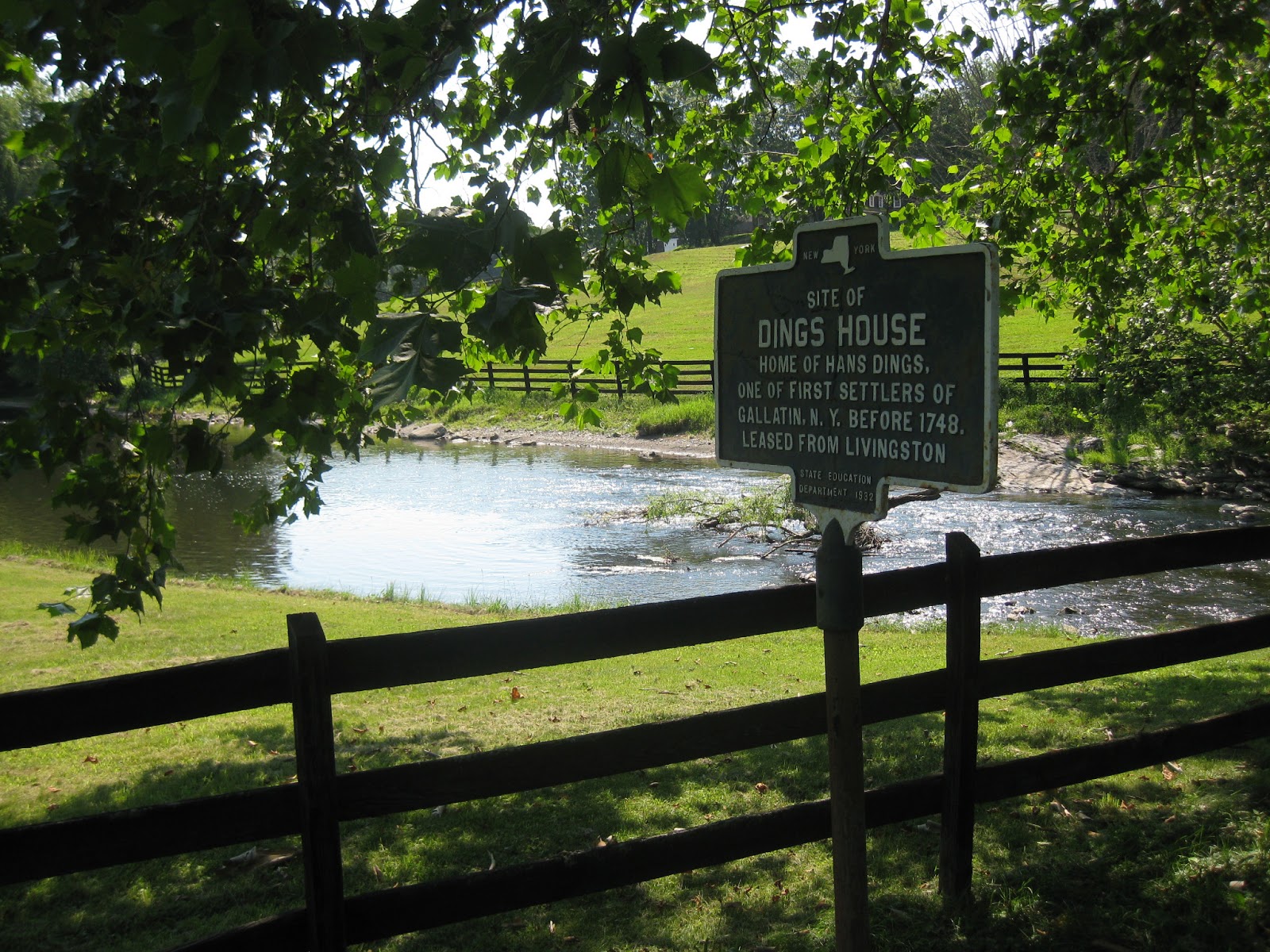
Site of Tenant Hans Dings House, on the Roeliff Jansen Kill, Silvernails
The population on the Manor continued to grow slowly, both from new tenants and black slaves that the first Lord of the Manor acquired. A census in 1718 reported 126 Palatine households, some 499 tenants were living on the manor. For several of their last years both Robert and Alida were in poor health. Livingston worked to carefully preserve his legacy, even to the extent of securing the political offices he had acquired for his eldest surviving son, Phillip, who became the 2nd Lord of the manor. To Robert Jr. he gave 160,000 acres at the southern end of his estate,  that became the manor of Claremont. A family tradition holds that Robert Jr. with conspicuous bravery once thwarted an attempt by slaves to kidnap or kill the elder Livingston, and so he was given special consideration, though there is no apparent documentary evidence to substantiate this story.5

In 1728 the tough Scotsman who made a personal empire, starting with little more than talent, ruthless determination and cunning, died. He was preceded by his remarkable wife and partner in business and life a year earlier.

Wire Rd., Linlithgo

Marker of the Week -- Right Location, Wrong Battle?

 While NYSHM's are usually pretty accurate, their location  is occasionally wrong.  In this case, the reverse seems to be true. In 1755 Colonial forces and their Indian allies under William Johnson collided with French Regulars and their Indian allies. In a number of bloody engagements Johnson fought off the French under Baron Dieskau. The Baron was wounded and captured and the French broke off the battle retreating back north.  Following this Battle of Lake George, Johnson built a fort, Fort William Henry, on the high ground next to the battlefield.  Two years later, in 1757, the French returned to lay siege to the Fort, this time led by Montcalm. (When the Battle of Lake George occurred Montcalm had been living the life of a contented rural squire in the French countryside with his two young daughters, which he adored.) During this later battle, known as the Battle or Siege of Fort William Henry, the Colonial forces occupied a fortified encampment on the older battlefield. It is here in huts their sick and wounded were probably housed. Other wounded, from the siege itself were sheltered in the casements of the fort itself. Following the textbook siege that left the Fort shattered and indefensible the British Commandant surrendered,  with the understanding that the garrison and their families would be permitted to leave for Fort Edward unharmed. The Indian allies of the French, however, felt they were being cheated out of the spoils (scalps, prisoners and plunder) they were promised. After the surrender they rampaged through the British fort and encampment, scalping and taking whatever they could.

E-Mail Me: If you have comments about this blog or any other thing having to do with NYSHM's I would be delighted to hear from you. I would be especially interested if you know of any new or interesting markers or can report on any efforts to restore old markers. My email is tba998@gmail.com I look forward to hearing and sharing your thoughts on this blog. 


1 Court records also reveal a suit brought against him when he borrowed a violin to entertain his friends, and tried to return it to the owner,  broken in three pieces!
2Unlike English society in the 17th and early 18th Centuries, Dutch society regarded women much more as equals in the world of business. Women did not give up their “surnames” when the married. They owned property and often ran their own businesses. After marriage, they often became full partners with their spouses.
3Indentureship was a common practice in Colonial America
4Later in the colonial period several species of southern pines would be found to be excellent sources of resins for naval stores, leading to a major industry in the south, including in North Carolina, “the tar-heel state”.
5John, the eldest son died a few years before, while pursuing his father's interests in London. A younger son, Gilbert, mismanaging his affairs almost to the point of bankruptcy. He was bailed out by his father, but not included in the will.